Eyes

I, too, have eyes—beautiful eyes!*

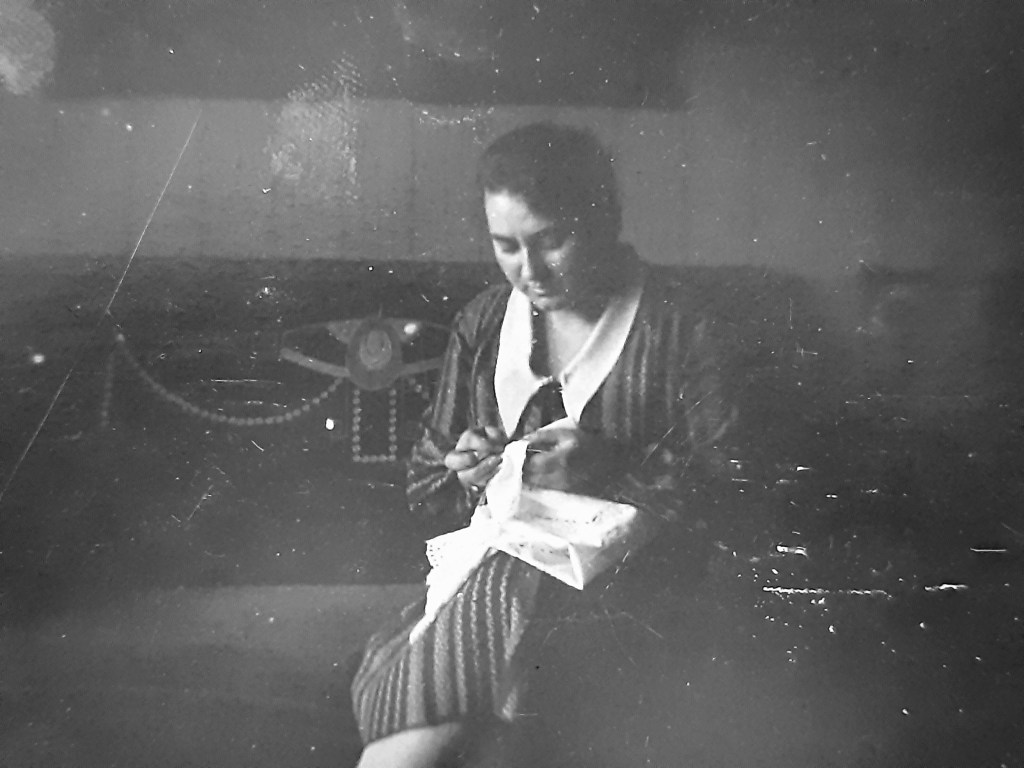
I am the daughter of a photographer. As a child, I never wanted to follow in my father’s footsteps because he lacked the patience to teach. Back then, I couldn’t see the world behind his eyes.
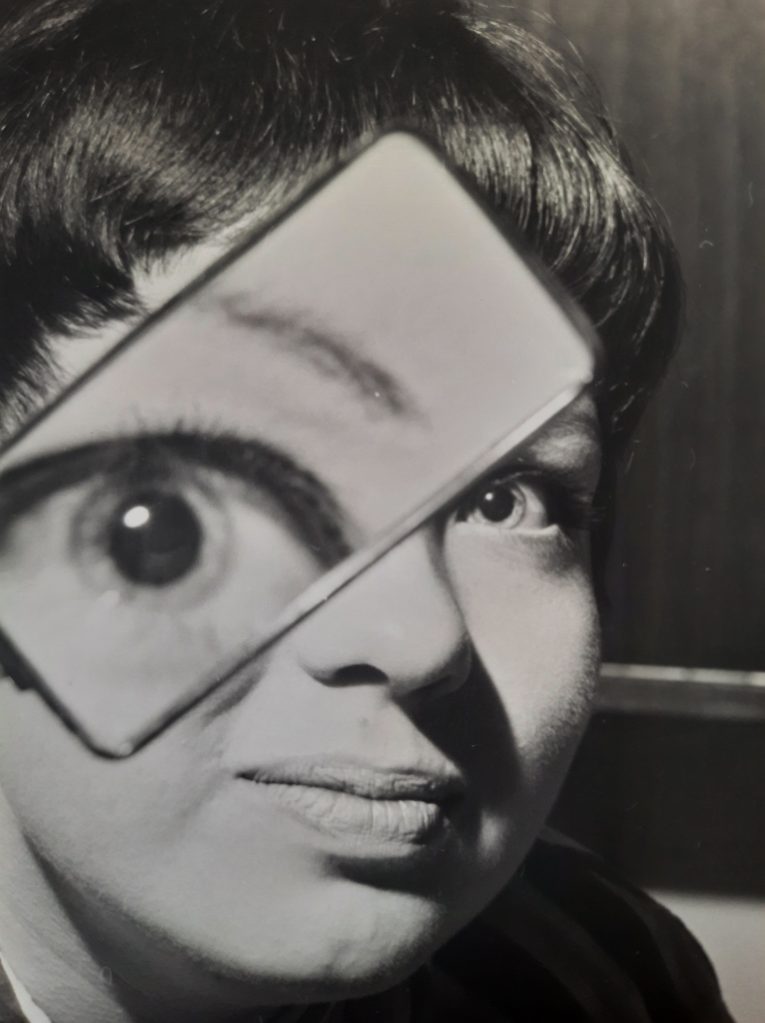
A black and white photograph of a person holding a mirror that reflects one of their eyes, creating an artistic visual effect.

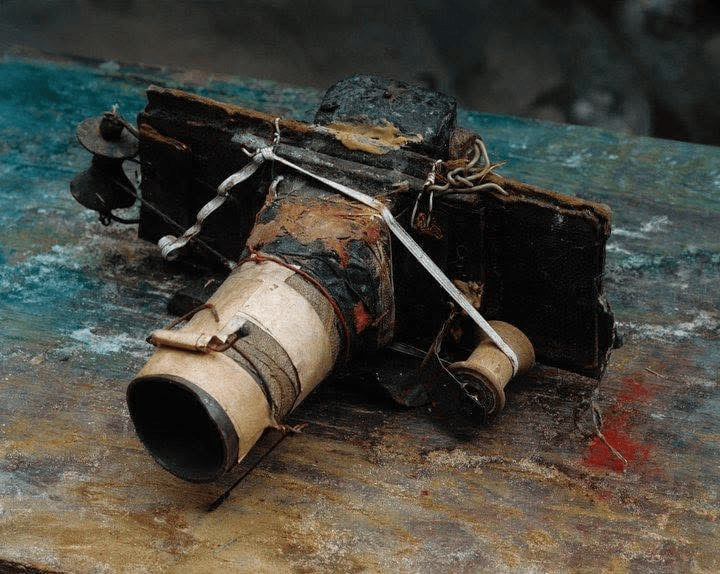
He was the son of an ambitious nation, born shortly before a devastating world war. When he was fourteen, the curious boy caught the wink of an optical lens in the trash. He fashioned his first camera and fell under the spell of the visual world—an encounter that would change his life forever.

Thirteen years later, then a young ballet dancer, he was drafted into service for a second world war. He decided he did not want to face the enemy with a weapon in his hand, but with a camera. He offered his services to the Wehrmacht as a photographer. From then on, he traveled to the theaters of war aboard a U-boat.

Whenever he surfaced from the breathtaking darkness of the deep waters into the liberating air of a coast, his third eye caught the cruel light illuminating horror and destruction. From the hostile cold of Scandinavia to the vibrant heat of Italy and the dry sun of Tripoli, he captured his impressions on rolls of celluloid.
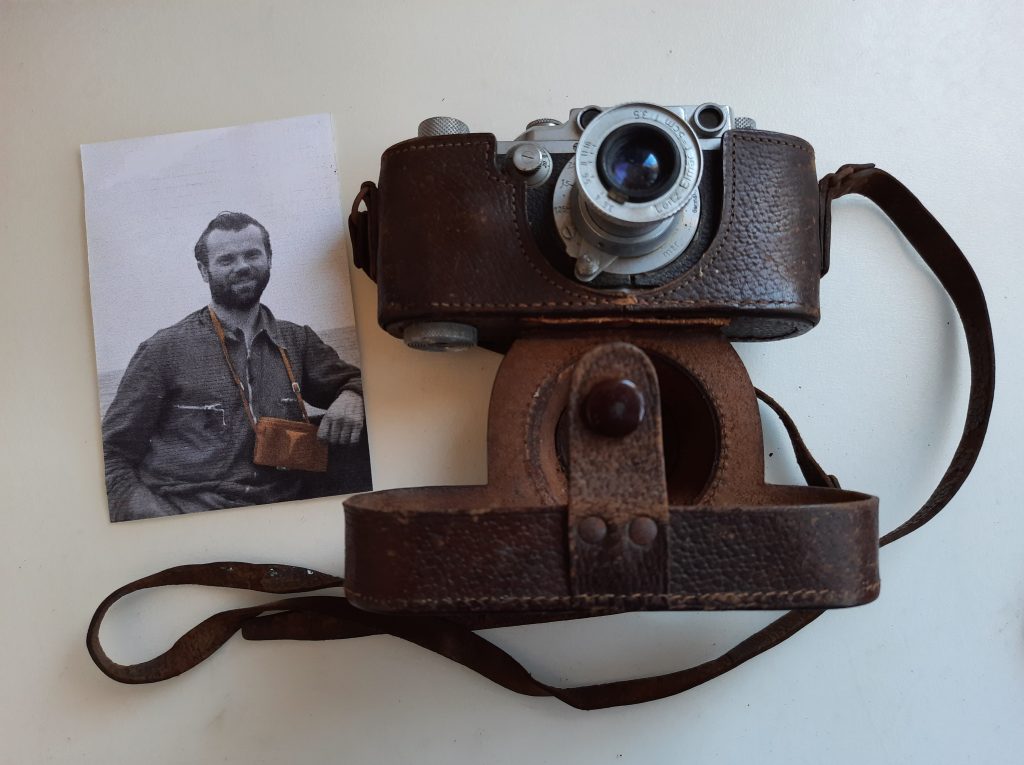
An antique camera with a leather case, positioned next to a black and white photograph of a smiling man wearing a camera around his neck.

While his camera recorded the terrible reality of battles on the front lines, the observer within him rejected those horrific images, choosing to remember only the beautiful pictures of adventures in foreign lands. From developing in the darkroom, the photographer knew darkness well. In the submarine, he had grown accustomed to the suffocating obscurity of the deep. When the war ended, the returning veteran set up his first studio in an underground bunker.

A ruined Germany licked its wounds. At forty, driven by curiosity, he photographed the windows of newly built homes like glittering eyes, the radiant eyes of newlyweds, and—with loving eyes—his wife and daughter. On photographic paper, he reproduced the world of his inner canvas, bearing witness to a new beginning and the rising and falling tides of his homeland.

Distant lands continued to lure the adventurer. Traveling the world, the curious Cyclops used his third eye to explore exotic vegetation, foreign cultures, and the people of distant shores. Later, having retired to a remote island, the old explorer upgraded his equipment, though his own failing eyes began to betray him. The lens of his camera became his way of navigating his surroundings.
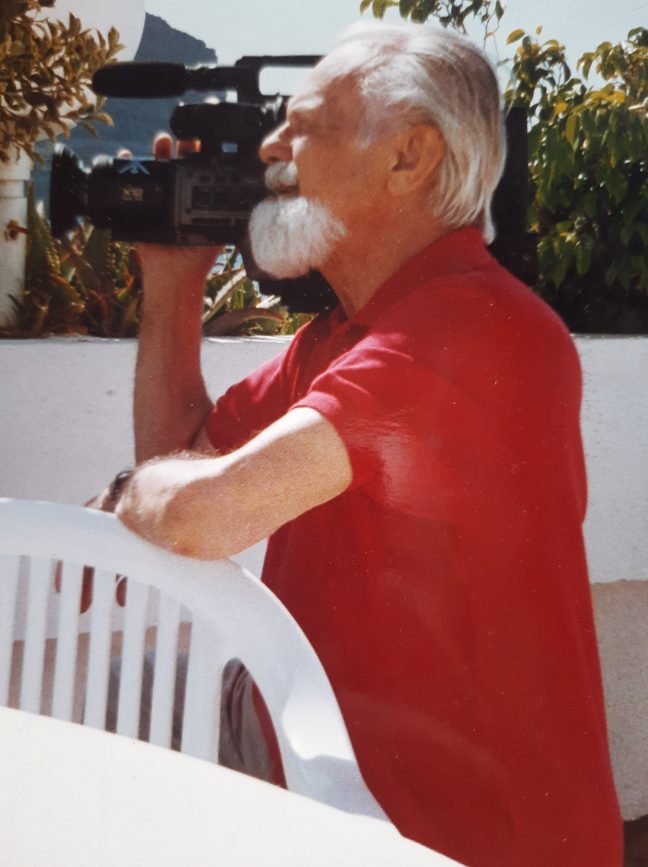
Koni Eimke with his video camera

When the light in his gaze finally went out, one half-blind eye remained open in a final stare. As I kissed him one last time, I realized that through his loving vision, he had taught me a love for life. In his photos, I see his perspective. Now that his lids are closed, I can finally see the world behind them.

* From ETA Hoffmann, The Sandman (1817)
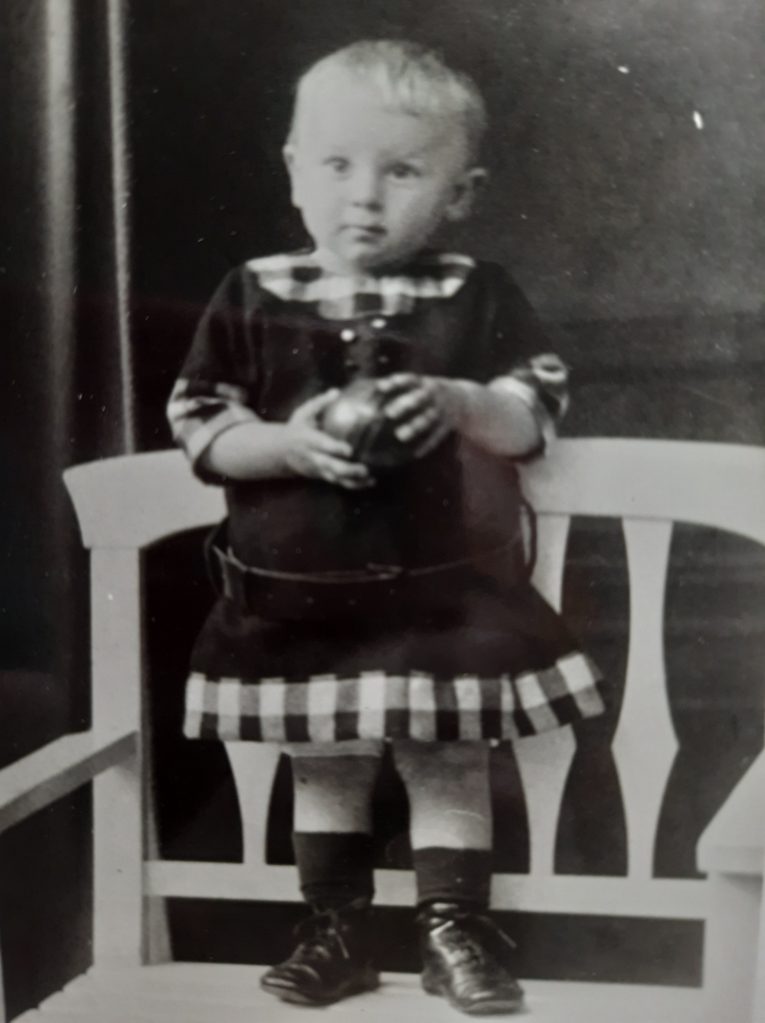
The Zeiss Lens

Growing up in the Wreckage of War

Little Rudi was chasing her around with a stool. He was three now. It was the second year of a world war, and food was scarce. Thank goodness, Frieda thought, that her milk was abundant. She unbuttoned her blouse, pulled out her breast, and, perched on the stool, the little boy began to nurse.

When the war ended, the surrounding ruins were a playground dream for the neighborhood kids. Frieda had forbidden him from going near them, but he was stubborn and wouldn’t listen. More than once, he came home with a bloody knee and torn clothes. She would have to mend them. The shops were bare, and money was tight.

By the time he was fourteen, Rudi and his friends were still exploring places where they hoped to unearth something interesting. From a pile of rubble, a Zeiss lens glinted in the trash. It was a treasure for the teenager.

“Mommy, Mommy!” he called out. “Look what I found! At school, they taught us about the camera obscura and a man named Daguerre. I’m going to build myself a camera!”

Foto: Roman Buxbaum – Tichý Ocean Foundation

Thank goodness he’s a good student and uses his time well, his mother thought. Aside from being rather messy, frequently ruining his clothes, and hating to wash up, he was a low-maintenance child. He’ll figure things out, Frieda reassured herself.

“What’s for lunch?” she heard him call from the stairs.

“Wipe your shoes before you come in!” she called back. Now it was her turn to chase him—not with a stool, but with a mop. He had left a trail of muddy footprints, and her husband could not stand a dirty house.

The Pleasure of so many little Things

Tiny details of life in a world full of wonders

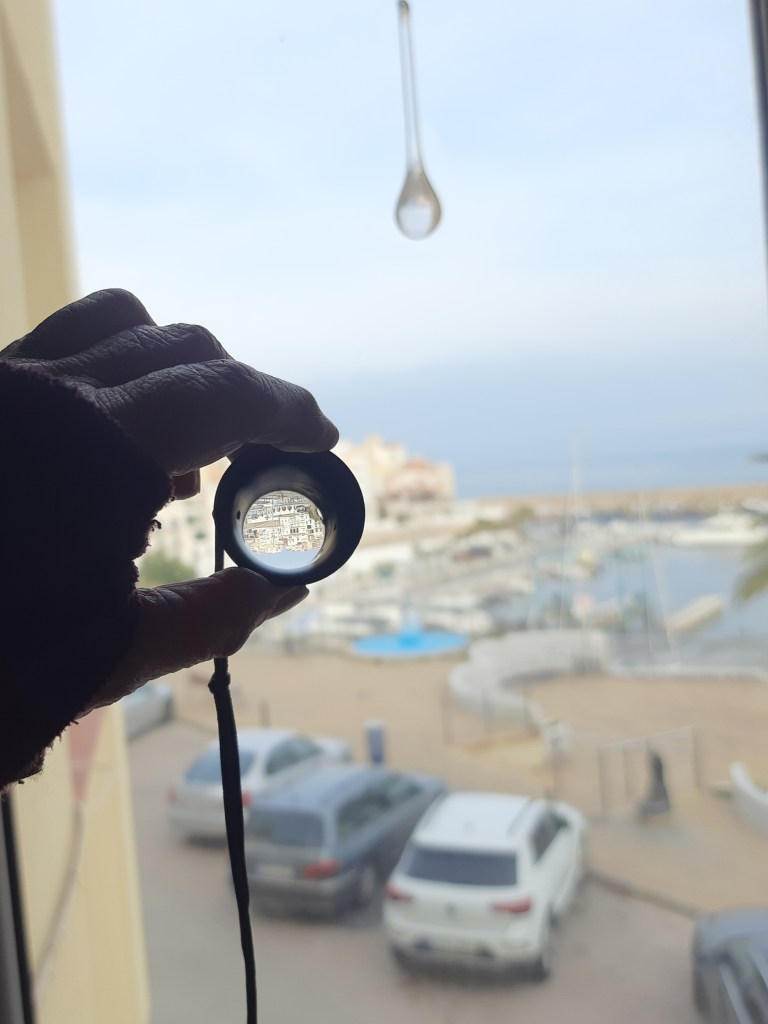
Rummaging through my drawer, a black cord keeps me from closing it. I tug on it, and tied to a carabiner hook covered in green rust, a black funnel-shaped object appears with a lens at its narrow end. Its Bakelite body is missing a small triangular chip where the lens screws in, and the lens itself is chipped too. “Darn it!” I hear my father say as he bends down to pick it up from the floor. It is his jeweler’s loupe, which he used to touch up tiny imperfections left by dust particles on photos using a fine brush dipped in black or white ink.

I remember a day during summer vacation. I had been given a microscope for my birthday. While running through my aunt’s garden, I scrapped my knee. I ran into the house, curious to look at my blood. It was teeming with round red particles that moved!

Better not look at the dust on my desk, just in case it moves too… I lift the loupe and try looking through it toward my window. I move it closer and farther from my eyes until the inverted, tiny image of my village appears. That is how it reduces. I flip it over. At two centimeters, it enlarges the minuscule print on an instruction manual. Closing one eye, I hold the loupe in the other. I can’t see a thing until the object is about ten centimeters away.

I look at my finger, magnificently magnified. I am amazed by the landscape of fingerprint ridges and grooves. Did you know that papillary ridges are dotted with countless tiny pitted specks? I get close to my dog’s blue eyes. Around the black pupil, I see feathery strokes of sky blue, encircled by a soft bluish-white ring laced with delicate veins.

I laugh quietly to myself. I have completely forgotten what I was looking for in the drawer. Standing here with my father’s loupe, I realize it doesn’t matter anymore. For a moment, I am not just looking through a lens; I am looking through my father’s eyes at a world full of wonders, sharing the exact curiosity that made him pause and pay attention to the tiniest details of life. Without knowing it, this was what I needed to find all along. 

Cyanotypie – a workshop

Paulo Cacais at Tigomigo Gallery

In June 2018 I enrolled in a workshop at Terrassa’s wonderful art gallery Tigomigo. Its owner Paulo Cacais introduced us to the secrets of cyanotypie.

Cyanotypie is a photographic process that results in cyan or Prussian blue prints. It was invented in 1842 by Sir John Herschel. British botanist Anna Atkins used it immediately in a series of botanical books published in 1843. She can thus be considered the first (female) photographer. Blueprints were widely used for many decades in architectural offices until alternative methods were invented in 1942 . Artists still use it today.
Blueprint works of R. Eretz and L. Elkivity

During my visit to Tel Aviv at the end of 2017, I was fortunate to meet the artists Rachel Eretz and Lucy Elkivity in their studio and admire their co-operative blueprint works (left). The technique resembles the sun-dyed pareu we used to make in the Cook Islands. I became curious to find out if I could use this method on tapa.

I took some pieces of Tongan tapa with me to the workshop. In his dark room, Paulo showed us how to dissolve small amounts of potassium ferricyanide and ferric ammonium citrate in warm distilled water and apply the greenish solution with a brush to the surface of our substrates. The prepared pieces were then left in a dark place to dry.

Circles and gauze
My first idea with embroidery frames and gauze fabric did not give good results, since it had to be kept inside so the wind would not blow it away and could thus only be developed through the window.

weeds as print material

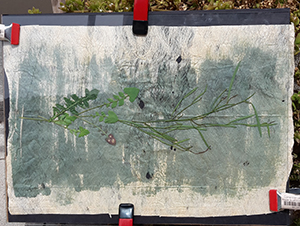
On a supporting frame, under glass plates held in place with clips I could then arrange my printing material on the dried substrates. I opted for plant material which I found outside the gallery.


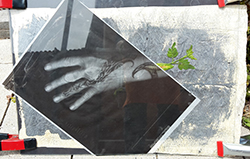
Paulo had the great idea to scan my hand, print it out on transparent paper and use it as a “negative” that the sun could develop. It is amazing how quickly the colour of the chemicals turns from a light green to a greyish blue right and beyond.
hand print - undevelopedhand print developing


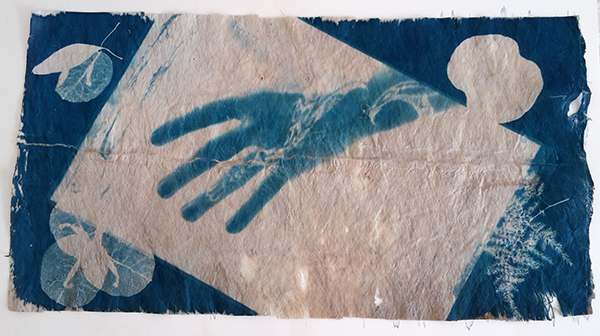
If left in the sun long enough, one achieves a beautiful dark Prussian blue, while the parts that the sun can’t access remain white (or the colour of the substrate).

hand print - developed

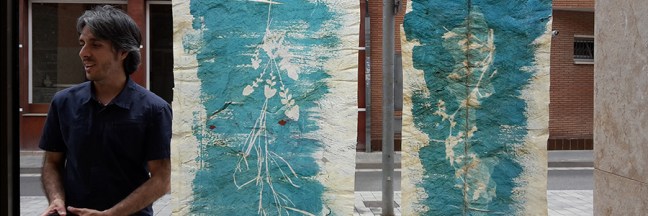
To dry the developed “photographs”, the wet pieces were just stuck to the large window of the gallery. I was so pleased with the outcome that I could not help but take a selfie…
Andrea and one of the blue prints