Le Provençal

A love story in a bottle.
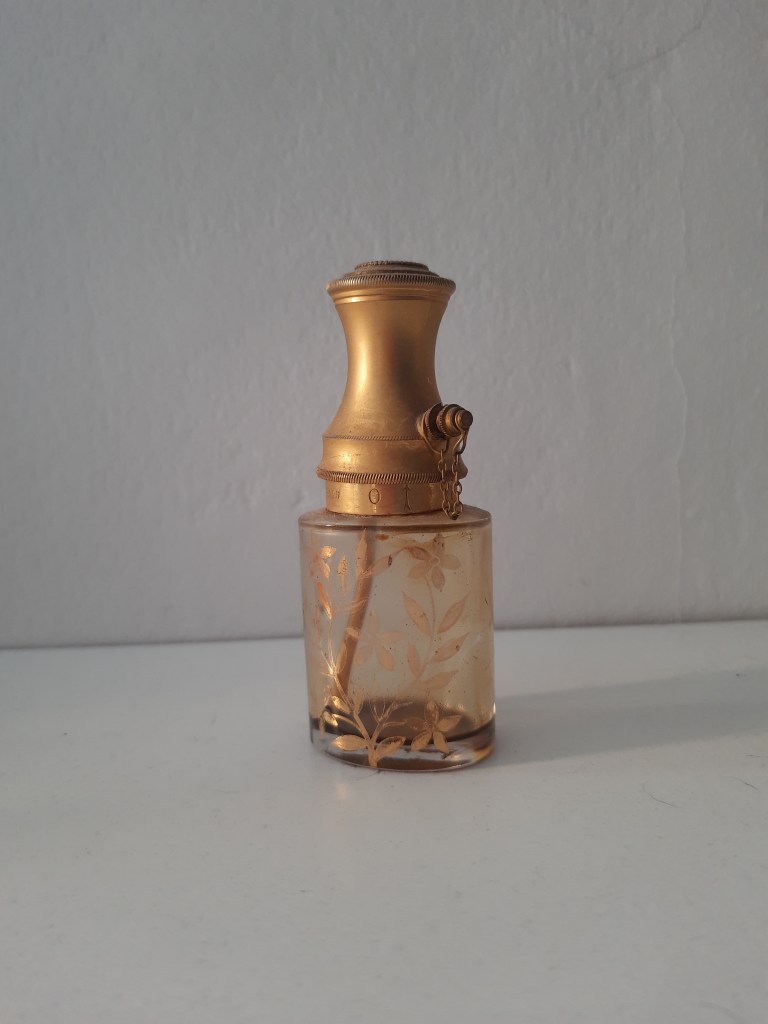
Vintage glass perfume bottle with gold floral decoration and ornate brass cap

“Your home is like a museum!” Gemma writes to me when I lend her my place for a while.

It’s true. Looking around at so many objects now, my apartment fills with a chorus of voices, each shouting over the other to tell its story—some long forgotten, others still vivid.

One soft, elegant voice stands apart. It draws me in precisely because it doesn’t scream like the rest. A small glass bottle, about four inches tall, catches my eye. It is hand-painted with golden leaves and flowers, topped with a brassy cap shaped like a fire hydrant. Instantly, I see my mother’s vanity table, where this tiny treasure rested from my childhood until her death in 2003.

Le Provençal – Molinard, reads the label on the cap, whose threads have been broken for years. I lift it. Like Aladdin’s genie, the perfume escapes from the dark brown residue clinging to the bottom of the bottle. Even after so many decades, it hasn’t lost its elegance or charm. My mother’s essence, I think.

No. 48 – Jeune – Grasse is printed near the base. Yes, she had been young back then, on those holidays in the South of France. Young and beautiful. I can see the lavender fields, the wild horses of the Camargue, the Roman ruins of Arles, and the bridge of Avignon. I hear my mother’s rich voice singing, “Sur le pont d’Avignon, on y danse…” and the buzz of the mosquitoes inside our tent—the ones that ate only my father and me alive. I see her eyes sparkling as she sampled the fragrances at the oldest perfume factory in France. And I remember her sheer delight when my father gave her that solid perfume sample set and this little bottle.

He loved her so very much.
Speed dating

1940

One day, I complained to my mother that I had no idea how to find a boyfriend.
“Don’t worry, darling,” she said. “One day, he’ll just knock on your door.”

Yeah, right, I thought and grimaced.

Seeing the doubt on my face, she decided to tell me how she met my father.

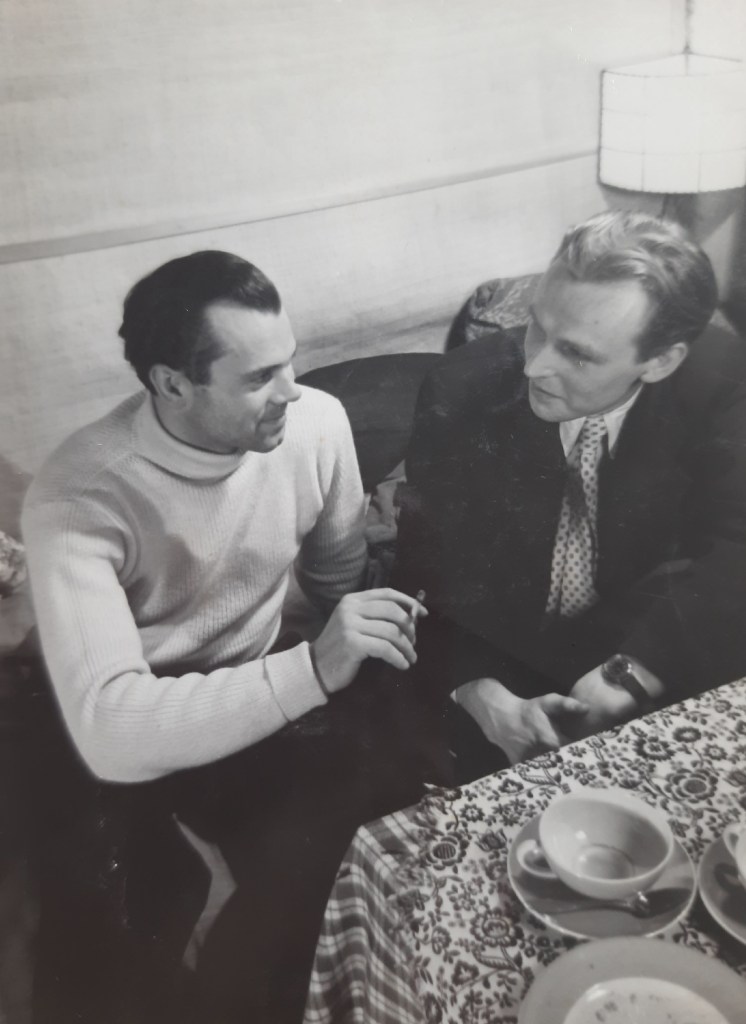
“It was the spring of 1939 in Berlin. I was sharing an apartment with my girlfriend Toni, who was studying textile design at university, and Ellen, a classmate of mine from fashion design school.That particular Saturday, it had poured with rain—typical April weather. On our way home, the three of us had been soaked to the bone. Now, a clothesline stretched across our living room, draped in a messy gallery of panties, bras, shirts, stockings, and dresses.Toni had just walked in and was in the bathroom washing her soiled clothes when the downstairs doorbell rang. I buzzed them in and listened to the heavy footsteps of two men climbing the stairs. It was eleven o’clock at night. Who on earth could that be at this hour? I wondered, checking to make sure the door’s safety chain was firmly in place. When they knocked on our door, I poked my head out, my hair wrapped in a towel after drying it. Standing there were two handsome young men—one in a trench coat and hat, the other in a leather jacket, both with their trousers drenched up to the knees. Small puddles were slowly forming around the tips of their closed umbrellas.

Black-and-white photograph of two men conversing at a dining table with teacups.
Koni and Fitz 1940

‘Does Miss Schneider live here?’ asked the tall blond one. ‘No, I’m sorry,’ I replied, preparing to shut the door. But then I noticed indignated that he had wedged his foot in the frame. ‘Could you please move your foot?’
‘Just a moment,’ said the one in the leather jacket. ‘I don’t understand. We just saw her come into this building, and she must have come up here, since this is the only apartment in the whole house with the lights on.’
‘That was my friend Lili Müller. Now please let me close the door and be on your way.’
‘What a shame. Our apologies, we must have made a mistake. We wanted to invite her and her friend out dancing. Would you ladies care to join us at the ballroom instead?’
‘No. It’s late, and the weather is terrible.’

The one in the leather jacket smiled at me.
‘How about tomorrow?’ He was handsome, I thought to myself. Why not? I caught sight of Lili peeking out from the bathroom door.
‘Lili, come here! These two guys are inviting us out dancing tomorrow. Do you feel like going?’
Lili looked at me, and I could see in her eyes that she loved the idea. And so, we made plans to go out the following evening with Koni and Fitz. Who would have guessed that a simple case of mistaken identity would end in two marriages, separated only by God many decades later?

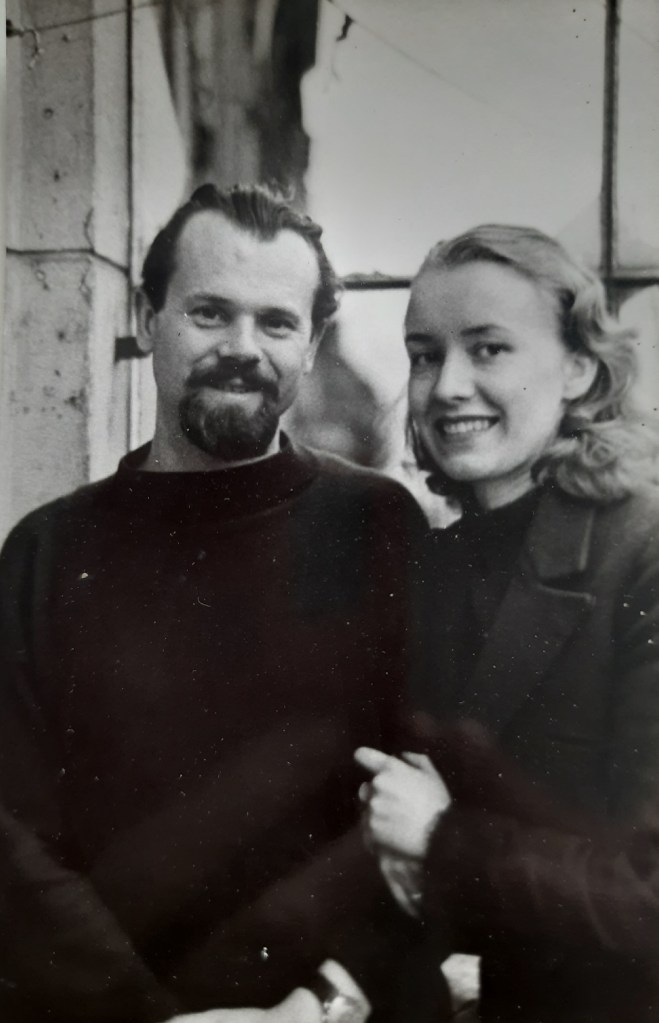
Black-and-white portrait of a smiling man and woman standing together indoors.
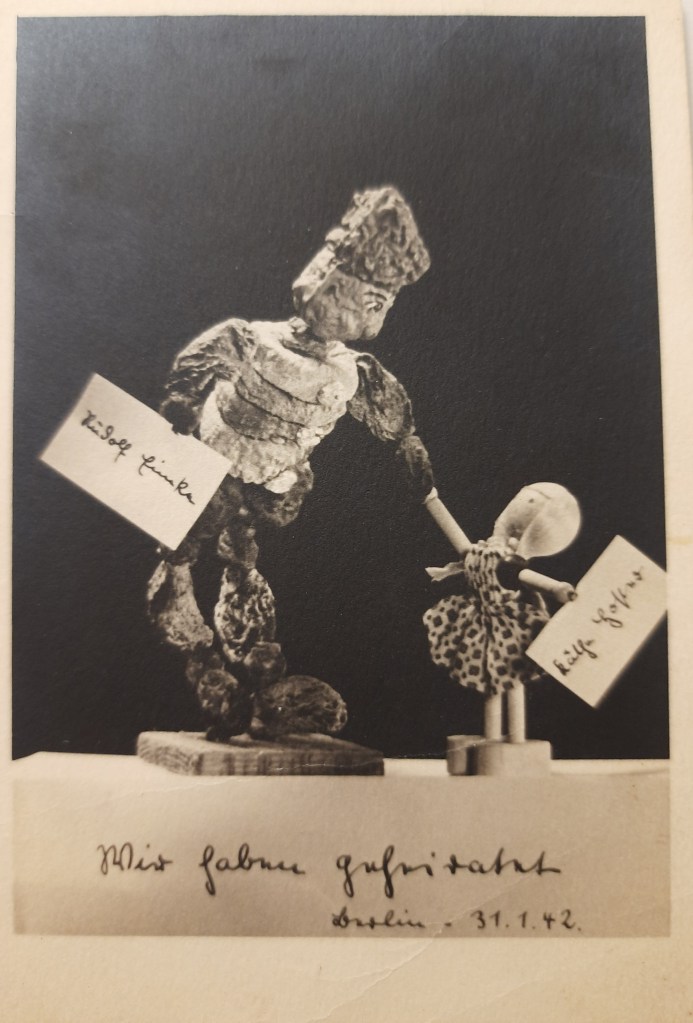
Katja und Koni at their wedding in Berlin 1942

Black-and-white photograph of a puppet performance featuring a costumed figure and a smaller seated figure with handwritten German labels.

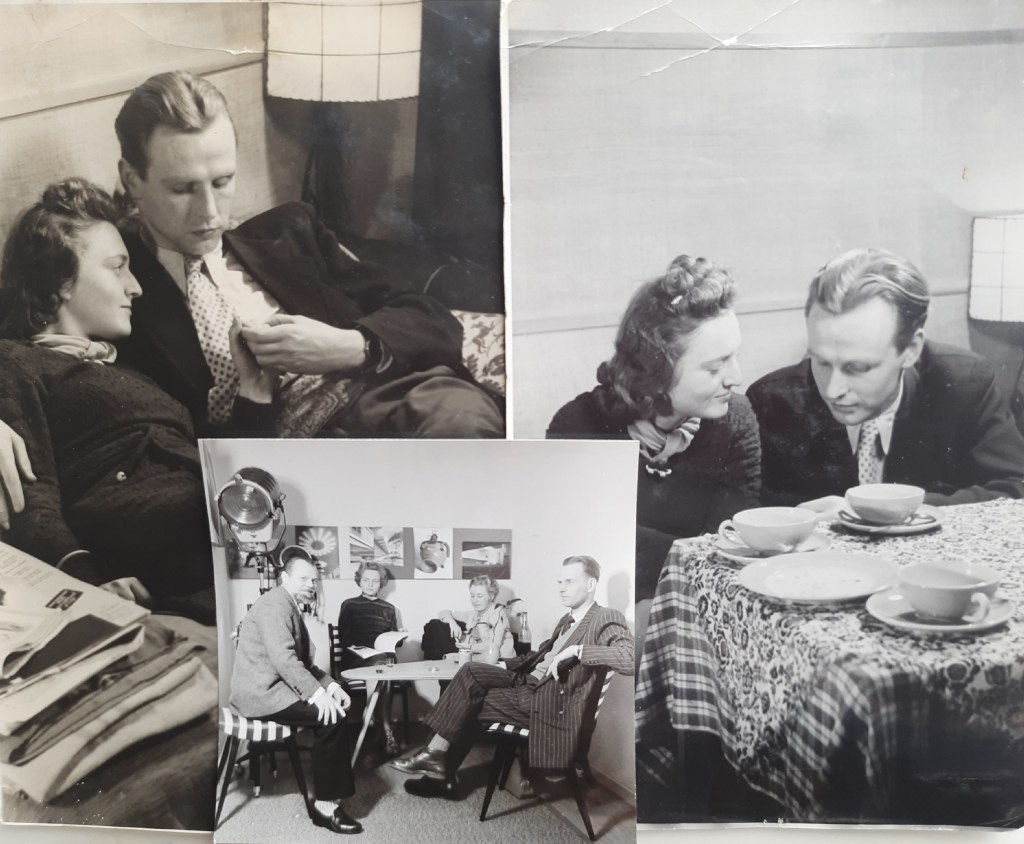
Collage of vintage black-and-white photographs showing a couple together and four people gathered around a table.
Lili and Fitz 1940 in Berlin and the two couples in the late 1950s at Koni’s Atelier in Düsseldorf

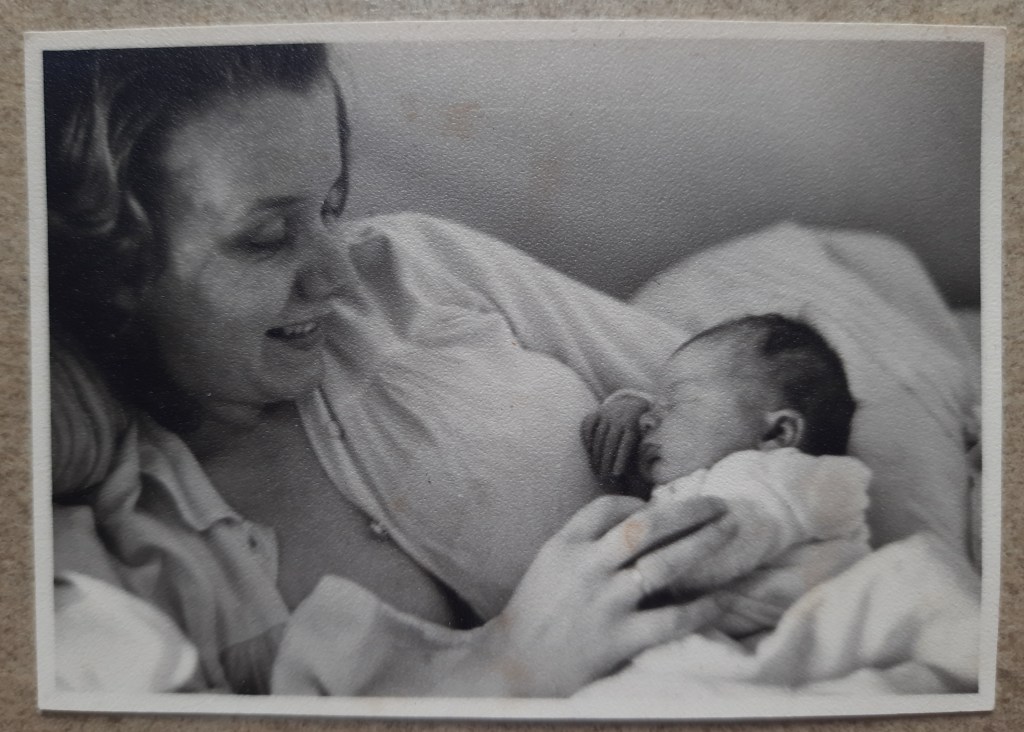
And eleven years after that night… you were born.”

Black-and-white photo of a mother smiling at her newborn baby in bed

Creative Impasse

Not much Science but some Fiction

A friend sent me the link to a Swiss painter’s website. I explore it with interest. I see oils, acrylics, three-dimensional works, and photographs.

Above all, her cyanotype prints captivate me. I submerge myself in a web of white lines: shiny filaments on a deep blue background. I pause to digest what I’ve seen. I look up toward the window in front of my desk, where a similar image surprises me. Above the whitewashed stone cubes of my town and the expanse of the cobalt sea extends, like a net of scars, a tangle of vapor trails that cross and lose themselves in the azure nothingness. Superimposed, an army of gray lenticular clouds evokes the silhouette of several UFOs.

To board one of them, I think, and fly to distant, ephemeral worlds—worlds that no longer exist anywhere but in my memory. To lose myself once again among the caresses of cotton fabrics and natural fibers. To let myself be carried away once more by the adventure of turning that delicate image into tangible matter. To create a space of dreams where reality vanishes on the threshold of the borderland, where the interstice transforms into a physical sensation of nothingness.

Ma, as the Japanese call it. For them, the space between things is not empty, but filled with energy: a force that moves you, inspires you, and lifts you up, like a flight inside a lenticular cloud. A possible interaction with the foreign, whether object, plant, animal, or human. Everything possesses a soul, a sensual promise, and deserves respect. The other, the unknown, is that which disquiets and at the same time fascinates; that which invites exploration. Is it not similar, perhaps, to being aboard that fictional alien ship?

I imagine black spheres descending on thin strings from that cloudy craft. As they draw near, the skeins unravel, turning into wavy filaments and shaping letters. They enter through my window and gather on my computer screen. As if holding hands, they weave sentences. I press a few keys to save this extraterrestrial text. What a rescue for a blocked writer!